
Journals Metric

See more informatiom in Journal Metrics

Publication start year 2019
Number of Volumes 17
Number of Issues 33
Number of Authors 964
Number of Submissions 972
Number of Reject Articles 368
Number of Accept Articles 403
Number of Reviewers 286

"Iranian Journal of Pulses Research" is a scientific journal that has been regularly and continuously published in semi-annually form (two issues per year) since June 2019.
This specialized journal publishes the results of legume research in various fields, including agriculture and agronomy, breeding and biotechnology, ecophysiology, resistance and tolerance to biotic and abiotic stresses, plant medicine, food industry, agricultural economics, mechanization, etc., in the form of research manuscripts publishes after reviewing.

Last site update: 2026.09.02

Original Article Breeding

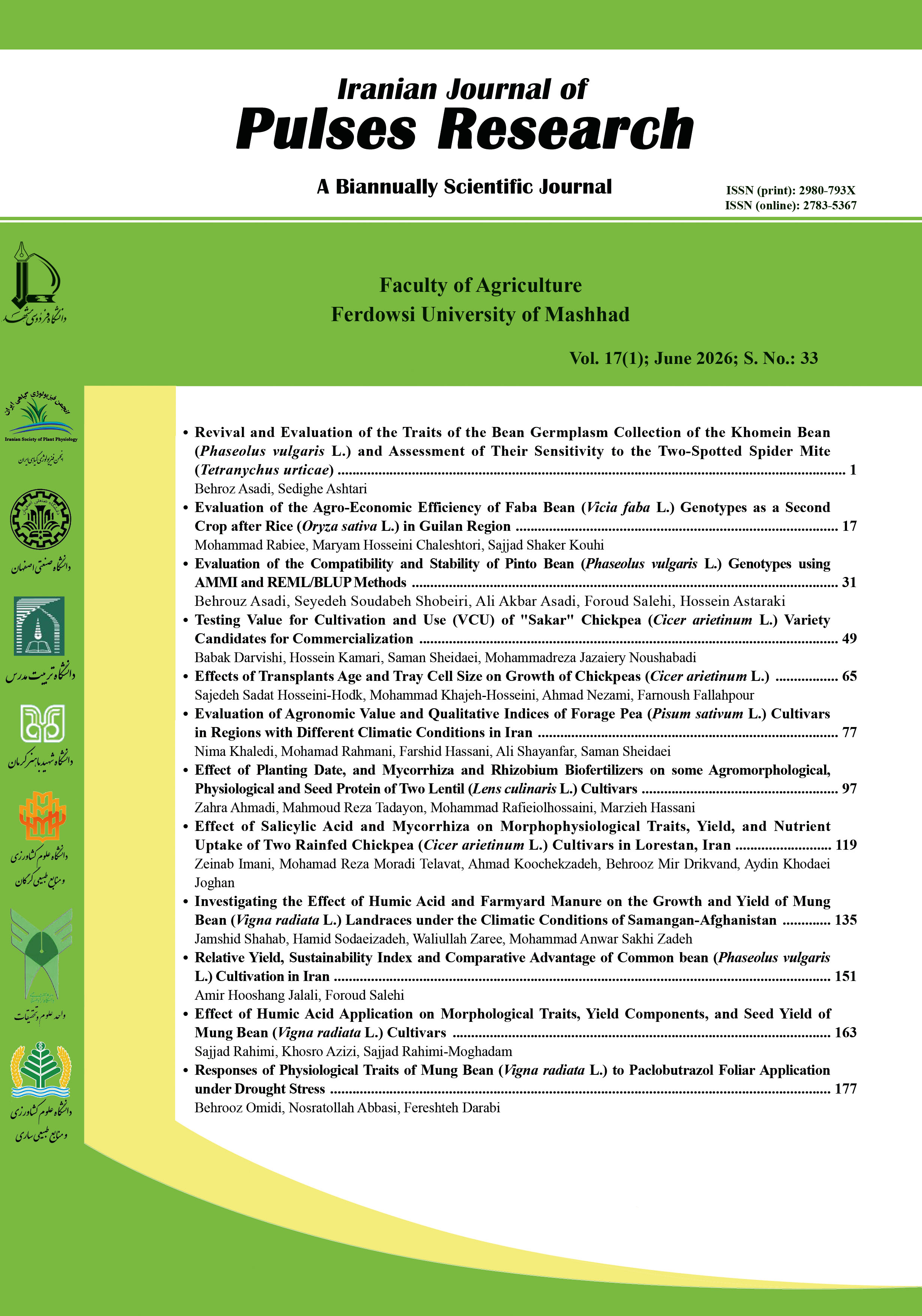
Revival and Evaluation of the Traits of the Bean Germplasm Collection of the Khomein Bean (Phaseolus vulgaris L.) and Assessment of Their Sensitivity to the Two-Spotted Spider Mite (Tetranychus urticae)

Pages 1-16

https://doi.org/10.22067/ijpr.2026.96585.1123

Behroz Asadi, Sedighe Ashtari

Abstract Introduction
Given the projected population of nine billion by the year 2050, and despite the increase in crop yields, concerns about food security still remain. Among various agricultural crops, legumes play a significant role in providing human food. These plants have high nutritional value and are the most important food source rich in protein (11 to 32 percent) (Schoonhoven & Voysest, 1991). An appropriate combination of legume proteins with cereals can alleviate malnutrition and amino acid deficiencies.

Materials and Methods
To regenerate and evaluate certain traits of the accessions in the bean (Phaseolus vulgaris L.) collection of the Khomein Bean Research and Education Center, an experiment was conducted over three years. A total of 720 bean accessions of pinto, red, and white types from the Khomein bean collection were planted using an augmented design. The number of blocks varied each year depending on the number of planted accessions: in the first year, the accessions were planted in 19 blocks; in the second year, in 14 blocks; and in the third year, in 12 experimental blocks. Each spring, after land preparation, furrows and ridges were created at 50-cm intervals, and the seeds of each genotype were planted on two rows of two meters. Plant spacing within the rows was set at 50 cm, and one unplanted row was considered between each experimental plot. To determine block uniformity during data analysis, three check varieties were used: the pinto bean cultivar ‘Kousha’, the red bean ‘Ofogh’, and the white bean ‘Dorsa’. All required agronomic practices—including irrigation, weed control, pest and disease management were applied uniformly across all blocks. Data were recorded for days to maturity, plant type, yield, and hundred-seed weight. Lines with a visual damage scale of less than 2.5 were considered resistant; those rated 2.5–3.7 as moderately resistant; 3.7–4.6 as moderately susceptible; and 4.6–6 as susceptible. For quantitative traits, descriptive statistics, including arithmetic mean, dispersion, range, variance, standard deviation, and coefficient of variation were estimated. Excel and SPSS software were used for data recording, analysis of variance, and chart preparation.

Results and Discussion
The results showed that the genotypes under study exhibited variation for the measured traits. The greatest amount of variation observed during the three years was related to grain yield, followed by hundred-seed weight. One of the main objectives of establishing gene banks and collections is the conservation of plant genetic resources and the utilization of storable materials in breeding programs through the use of their desirable genes to increase production, either directly or indirectly, under various biotic and abiotic stresses. For selecting desirable bean accessions, traits such as yield, earliness, marketability, and plant growth habit are of great importance. Based on the seed yield and maturity period of the genotypes over the three years of the experiment, a biplot of these two traits was used (Figures 1 to 3), and the accessions with above-average yield and early maturity were selected. The characteristics of the selected genotypes for each year are presented in Tables 8 to 10. The greatest amount of variation in common bean has been reported for number of pods per plant, yield, and hundred-seed weight, and this variation contributes the most to the development of high-yielding cultivars. In addition, pod number per plant has high heritability, and this trait is influenced by factors such as the number and size of leaves on the plant. Because of its positive correlation with yield, it should be considered a key criterion when selecting high-yielding plants (Dargahi et al., 2008). Similarly, Ashtari et al. (2020), in their evaluation of the tolerance of several promising bean lines to the two-spotted spider mite under greenhouse and field conditions, concluded that the Dadfar cultivar and line 31286 exhibited higher resistance indices compared with the other genotypes, and they recommended these genotypes for cultivation in the region. These findings indicate that it is possible to identify mite-tolerant genotypes within bean populations, and that this trait can be utilized to reduce dependence on chemical pesticides.

Conclusions
Based on the results obtained from this project during the restoration and evaluation of part of the accessions in the bean collection of the Khomein Bean Research and Education Campus, a total of 64 accessions with above-average yield and early maturity were selected over the three years of the project. These selected accessions will undergo further detailed evaluations.
Original Article Agronomy

Evaluation of the Agro-Economic Efficiency of Faba Bean (Vicia faba L.) Genotypes as a Second Crop after Rice (Oryza sativa L.) in Guilan Region

Pages 17-30

https://doi.org/10.22067/ijpr.2026.96983.1125

Mohammad Rabiee, Maryam Hosseini Chaleshtori, Sajjad Shaker Kouhi

Abstract Introduction
Despite having a high potential for paddy fields in Northern provinces, unfortunately, most of these paddy fields are left unused for about 7 months after rice (Oryza sativa L.) harvesting. The presence of fertile soils, a long growing season, and favorable environmental conditions between rice harvest and planting the following year make these paddy fields well suited for cultivating a second crop. Faba bean (Vicia faba L.) is one of the most important legumes that is adapted to the climatic conditions in most Northern regions of Iran. Given the large areas of paddy fields in the North of Iran, utilizing these areas for faba bean cultivation after rice harvesting can be an effective strategy for increase land productivity, sustainable rice production, higher paddy farmers' income, achieving self-sufficiency and ensuring food security. Among legumes, faba bean has one of the highest rates of biological nitrogen fixation, improving soil fertility by leaving residual nitrogen benefitting subsequent crops. The use of suitable varieties can play an important role in development and sustainability of faba bean cultivation in paddy fields. Therefore, the main objective of the present study was to examine the yield and economic indices of different faba bean genotypes as a second crop in rotation after rice.

Materials and Methods
This study was conducted based on a randomized complete block design with three replications at the research fields of Rice Research Institute of Iran in Rasht during two cropping seasons of 2023-2024 and 2024-2025. The experimental treatments included four varieties (Feyz, Barkat, Shadan and Mahta) and two promising lines of faba bean (332 and WRB1-5). In this study, traits such as number of pods, number of seeds per pod, 100-seed weight, green pod yield, grain yield, biological yield, harvest index and protein yield were evaluated. Additionally, gross and net profit, percent of sale return, and benefit-cost ratio, were assessed to evaluate economic indices. The protein content of samples was determined by the Kjeldahl method. After measurement of the sample total nitrogen by applying factor 6.25, the seed protein content was measured. Data was analyzed using SAS 9.2 and mean comparisons were done by least significant difference (LSD) test at the 5% probability level.

Results and Discussion
The results of combined analysis of variance revealed that genotype had significant effect on all studied traits. Mean comparison showed that the second year of the experiment had higher green pod yield (24518 kg.ha-1), grain yield (5060 kg.ha-1) and protein yield (1535 kg.ha-1) compared to the first year. Between faba bean genotypes, the highest green pod yield with an average of 28883 and 27217 kg.ha-1 and the highest grain yield with an average of 6025 and 5653 kg.ha-1, respectively, were obtained from Feyz and Barkat varieties. The Shadan variety was also in the next position. The lowest green pod yield (17181 kg.ha-1) and grain yield (3662 kg.ha-1) was obtained in Mahta variety. The highest biological yield (18368 kg.ha-1) and harvest index (32.8%) was related to the Feyz variety. The Mehta variety also had the lowest biological yield (11996 kg.ha-1) and harvest index (29.1%). Among the genotypes of faba bean, Mahta variety had higher protein content (32.1%). The highest and lowest protein yield was obtained in Feyz variety (1703 kg.ha-1) and line WRB1-5 (1016 kg.ha-1), respectively. Based on the results of stepwise regression analysis, biological yield, pods per plant, green pod yield and seeds per pod were entered into the regression model, respectively, and explained 95% of the variation in grain yield. The analysis of the economic indices showed that the Feyz variety ranked first in terms of gross and net profits with 3012500 and 2554650 thousand rials/ha, respectively. Barkat and Shadan varieties were also ranked next. Mahta variety had the lowest gross (1464800 thousand.rials ha-1) and net profits (1043450 thousand rials.ha-1) among genotypes of faba bean. Feyz, Barkat and Shadan varieties with percent of sale return and benefit-cost ratio (84.8 and 6.6), (83.6 and 6.1) and (79.7 and 4.9) were ranked first to third, respectively. The lowest amount of percent of sale return and benefit-cost ratio (71.2 and 3.5, respectively) were assigned to Mahta variety.

Conclusions
Based on the results of this study, the Feyz, Barkat, and Shadan cultivars are recommended, in that order, for faba bean cultivation as a second crop in the paddy fields of Guilan province due to their superior yield performance and greater economic returns. These findings indicate that integrating faba bean into rice-based cropping systems has the potential to enhance farmers' income while promoting the sustainability of rice production.

Original Articles Biotechnology

Evaluation of the Compatibility and Stability of Pinto Bean (Phaseolus vulgaris L.) Genotypes using AMMI and REML/BLUP Methods

Pages 31-47

https://doi.org/10.22067/ijpr.2026.97257.1126

Behrouz Asadi, Seyedeh Soudabeh Shobeiri, Ali Akbar Asadi, Foroud Salehi, Hossein Astaraki

Abstract Introduction
In bean (Phaseolus vulgaris L.) breeding programs, the ultimate goal of researchers is to produce varieties with high yield potential to increase production in different environments. Due to the differences in the adaptability of genotypes in different environments, the yield of genotypes fluctuates in different environments, which is known as the genotype × environment interaction (GEI) and is the result of the different phenotypic responses of genotypes to environmental changes. It is of particular importance to understand the type and nature of the interaction and to obtain the figures that show the least reaction to the interaction. To account for GEI, breeders evaluate genotypes in multiple environments to identify genotypes with high yield and stability and genotypes that have a non-significant GEI are considered stable genotypes. There are various methods, such as parametric and nonparametric methods, to evaluate interaction effects but the best result is achieved when a genotype shows similar results of stability with different evaluation methods. Therefore, identifying and developing stable, high-yielding cultivars that perform consistently across diverse environmental conditions is a major objective of pinto bean breeding programs. To this end, the present study evaluated the yield stability of 13 pinto bean genotypes across multiple environments using multivariate stability analysis.

Materials and Methods
In order to compare the yield and study the compatibility of bean genotypes, 12 bean genotypes along with the Kosha cultivar (check) were studied in a randomized complete block design with three replications in four regions: Khomein, Boroujerd, Shahrekord, and Zanjan for 2 years. The F-test of sources of variation was performed based on the arithmetic Mean of squares expectation, assuming randomness of years and locations (environments) and fixed genotypes. To determine the stability and compatibility of genotypes, AMMI multivariate methods and BLUP-based linear mixed model were used, and WAASBi and WAASBYi stability quantities were calculated to quantify stability.

Results and Disussion
A combined analysis of variance was performed assuming randomness of years and locations (environments) and fixed genotypes and it showed that the interaction effects of genotype × location, year × location and genotype × year × location were significant. The main effect of genotype, the main effect of environment (sum of main effects and interaction effect), and the interaction effect of genotype × environment (sum of dual and triple effects) explained 15, 39, and 40 percent of the total sum of squares, respectively. AMMI analysis of variance showed that the first to seventh principal components were significant and together explained nearly 100% of the variation in the genotype × environment interaction. The first and second principal components explained nearly 76% of the sum of squares of the GEI. Genotypes G11, G9 and G6 had the lowest values ​​of the IPCA1, and among them, only genotype G9 had a yield higher than the average total yield, which was introduced as a stable genotype with high general adaptability to all environments. Genotypes G8, G6, and G11 had the lowest values ​​of the second principal component of IPCA2; therefore, considering the yield, genotype G6 can also be introduced as a stable genotype in all environments. AMMI2 biplot showed compatibility of genotype G12 with Shah1 and Zan2, genotypes G2, G3 and G4 with Boro1, genotypes G9 and G13 with Khom1 and Khom2 and genotypes G1 and G8 with Boro2 environments. Based on the simultaneous selection criterion based on average grain yield and WAASB stability index, genotypes G7, G9, G8, G6, G1 and G3 with the highest WAASBY value were stable genotypes with high grain yield. Based on the biplot of grain yield versus weighted average absolute scores (WAASB), genotypes G7, G8, and G9 located in the fourth quartile had higher yields than the average yield of genotypes and were more stable than other genotypes. Finally, based on equal importance for yield and stability, G11 and G4 are stable and low-yielding genotypes, G6, G7, G8 and G9 are stable and high-yielding genotypes, G1, G3 and G5 are unstable and high-yielding genotypes, and finally G10, G12, G13, G20 and G2 are unstable and high-yielding genotypes.

Conclusions
Because the WAASBY index incorporates mixed-model analysis and all relevant components of genotype performance, it appears to provide a more comprehensive assessment of genotype stability and adaptability than the other indices evaluated. Based on the WAASBY index, genotypes G9, G7, G8, and G6 were ranked first through fourth, respectively, and were identified as the most promising genotypes.

Original Article Breeding

Testing Value for Cultivation and Use (VCU) of "Sakar" Chickpea (Cicer arietinum L.) Variety Candidates for Commercialization

Pages 49-63

https://doi.org/10.22067/ijpr.2026.97383.1127

Babak Darvishi, Hossein Kamari, Saman Sheidaei, Mohammadreza Jazaiery Noushabadi

Abstract Introduction
Chickpea (Cicer arietinum L.) is considered as a valuable legume crop that, in addition to having high nutritional value, is well adapted to rainfed farming conditions. Also, it is one of the most important crops in the semi-arid regions of the world, and is widely cultivated in Iran. In 2023, chickpea cultivation area in Iran is about 423,700 hectares and its production is estimated at more than 175,000 tons with an average yield of 413 kilograms per hectare. Developing new cultivars with superior agronomic performance and desirable consumer traits is essential for increasing yield, improving mechanization efficiency, and enhancing market competitiveness. The Value for Cultivation and Use (VCU) test is a critical step in the registration and commercialization process, as it verifies that new cultivars outperform existing commercial varieties in terms of agronomic performance and quality. The newly developed chickpea cultivar Sakar was selected for evaluation based on its promising morphological and physiological characteristics. The aim of this study was to investigate the agronomic performance and consumption-related characteristics of the "Sakar" cultivar in comparison with five commercial cultivars in diverse climatic conditions of Iran.

Materials and Methods
This study was conducted during two cropping seasons in three locations: Urmia, Naqadeh, and Karaj. A Randomized Complete Block Design (RCBD) with three replications was used to evaluate the candidate cultivar ‘Sakar’ alongside five control cultivars. Data collection was based on the national VCU testing protocol and phenological traits, yield components and seed quality were evaluated. Post-harvest traits such as water absorption index, seed swelling index and cooking time were measured using standard laboratory methods. Analysis of variance (ANOVA) was performed to assess differences among cultivars and mean comparisons were conducted using Duncan’s multiple range test at the 5% significance level. All statistical analyses were carried out using SAS software.

Results and Discussion
The candidate cultivar ‘Sakar’ was later flowering than the other cultivars with 154.4 days to flowering. Sakars flowering time was significantly delayed compared to the average of the other cultivars (152.7 days). ‘Sakar’cultivar with a maturity period of 190.7 days was classified in the late-maturing cultivar group along with ‘Nosrat’ (190.2 days) and ‘Ata’ (189.8 days). The first pod height in ‘Sakar’ (20.5 cm) was significantly higher than the mean of the other cultivars (17.8 cm), which is considered as an advantage for ‘Sakar’ mechanical harvesting. ‘Sakar’ also showed high branching (7.05 branches per plant), similar to ‘Ata’ (7.0) and ‘Nosrat’ (6.77). Although the number of pods per plant in ‘Sakar’ (39.4 pods) was significantly lower than the average of the improved cultivars (49.15 pods), it had the highest number of seeds per pod (1.15) and the highest 100seed weight of 37 g which was ranked in the highest statistical group with 100-seed weight in Saeed (37.9 grams) and Anna (37 grams) cultivars. ‘Sakar’ also produced the highest fresh seed weight (81.3 g) and showed a higher water absorption index (1.19%) compared to the general mean (1.12%). Its dry seed volume (83 mL) was the highest among the cultivars. Based on the seed swelling index (2.23) and cooking time (38.3 minutes), ‘Sakar’ was categorized as an intermediate cultivar. Overall, due to its higher first pod height and relatively large seed size, ‘Sakar’ can serve as an efficient and promising germplasm for breeding and production programs in regions with environmental conditions similar to the study areas.

Conclusions
The candidate cultivar ‘Sakar’ showed impressive agronomic performance in the evaluations; higher first pod height, adequate branching and relatively large seed size were its outstanding features. In addition, the sakar cultivar showed favorable quality traits such as higher grain fresh weight, higher water absorption index and higher grian dry volume. Although this cultivar was ranked at an average level in terms of grain swelling index and cooking time, the combination of all Sakar characteristics indicates that Sakar can be used as an efficient and promising germplasm for breeding and production programs in areas with environmental conditions similar to the experimental sites.

Acknowledgement
This article is extracted from the research project of the Seed and Plant Certification and Registration Institute under the approved number 04-08-08-050-011221 dated 2025/10/18 which is hereby thanked and appreciated.

Original Article Agronomy

Effects of Transplants Age and Tray Cell Size on Growth of Chickpeas (Cicer arietinum L.)

Pages 65-76

https://doi.org/10.22067/ijpr.2026.97397.1131

Sajedeh Sadat Hosseini-Hodk, Mohammad Khajeh-Hosseini, Ahmad Nezami, Farnoush Fallahpour

Abstract Introduction
Given the ongoing challenges of climate change and the increasing of shortages in water resources, there is an urgent need to reconsider conventional cropping systems. Promoting the cultivation of drought-tolerant and low water‑requiring crops such as legumes can substantially contribute to agricultural sustainability and food security. Chickpea (Cicer arietinum L.) is a major legume adapted to arid and semi‑arid regions, playing a vital role in improving soil fertility through biological nitrogen fixation. It is cultivated on approximately 17 million hectares worldwide. In Iran, although a large area is dedicated to chickpea cultivation, the average yield accounts for only about 30% of its potential capacity. Factors such as inadequate agronomic management, drought, high temperatures, and severe damage from pests and diseases, especially during early growth stages are considered the main causes of low yield. Direct seeding, which has long been the conventional method of chickpea establishment, often leads to poor and nonuniform seedling emergence under water-limited and harsh environmental conditions. In this context, transplanting represents a novel and promising approach to overcome these constraints by improving seedling establishment, optimizing water use, and enhancing tolerance to biotic and abiotic stresses. Therefore, this study aimed to evaluate the effects of seedling age and tray cell size on transplanting growth traits to identify effective strategies for improving transplant production and addressing challenges associated with water scarcity.

Materials and Methods
The experiment was conducted in February 2024 in the Research Greenhouse of the Faculty of Agriculture, Ferdowsi University of Mashhad, using a completely randomized design (CRD) with four replications. The treatments included two factors: transplanting age at three levels (4, 6, and 8 weeks) and tray cell size at three different volumes (24, 38 and 60 cm3). Chickpea seeds (cv. MCC770), obtained from the Faculty’s Research Farm, were sown in trays filled with a cocopeat–perlite substrate (7:3, v/v). To produce transplants of different ages, sowing was repeated at 2- and 4-week intervals following the initial planting. Transplants were grown under greenhouse conditions at 17–23 °C with daily irrigation throughout the growth period. Nutrient application was carried out two weeks after sowing, at the two- to three-leaf stage, using a complete NPK nutrient solution (0.2%). Eight weeks after sowing, emergence percentages, leaf area, shoot and root dry weight, root surface area, and root length were measured Prior to analysis, data were examined for normality and homogeneity of variances. Statistical analysis was performed using Minitab software (version 20), and means were compared using the LSD test.

Results and Discussion
The interaction between transplanting age and tray cell size was significant for all measured traits. In general, the highest leaf area and shoot dry weight were observed in 8 weeks transplants, whereas in the 4 weeks exhibited the greatest root surface area and root length. Increasing transplanting age markedly reduced the emergence percentages. However, 8 weeks transplants exhibited greater leaf area and shoot dry weight than 4 weeks transplants. This pattern indicates that spatial constraints during the nursery stage induced mild stress conditions, stimulating a compensatory growth response characterized by enhanced leaf expansion to improve post-transplant establishment. Negative correlations between emergence percentages and both leaf area and shoot dry weight further confirmed this interpretation, suggesting that reduced transplants density allowed greater access to growth space and consequently promoted shoot biomass accumulation. Correlation analysis revealed significant positive relationships among root dry weight, shoot dry weight, and leaf area, underscoring the pivotal role of root development in sustaining aboveground growth. Additionally, root surface area showed a positive correlation with emergence percentages, likely reflecting enhanced water absorption capacity in the lightweight and porous substrate. In contrast, its negative associations with leaf area and shoot dry weight suggest a shift in dry matter allocation toward root structures under spatial or resource limitations. Overall, these results highlight the necessity of maintaining a balanced root–shoot relationship to ensure vigorous chickpea seedling growth and successful transplant establishment.

Conclusions
Increasing transplanting age decreased emergence percentages but improved growth traits such as leaf area and shoot dry weight. Cell size also played a crucial role in root development and dry matter distribution among plant organs. Transplanting aged 4 weeks exhibited stronger root systems, with greater root length and surface area, making them more suitable for field transplantation. Overall, optimizing transplanting age and cell volume can enhance chickpea transplants quality by maintaining balanced root–shoot growth, hence a better establishment in the field.

Original Article Agronomy

Evaluation of Agronomic Value and Qualitative Indices of Forage Pea (Pisum sativum L.) Cultivars in Regions with Different Climatic Conditions in Iran

Pages 77-96

https://doi.org/10.22067/ijpr.2026.98116.1133

Nima Khaledi, Mohamad Rahmani, Farshid Hassani, Ali Shayanfar, Saman Sheidaei

Abstract Introduction
Global agriculture confronts critical challenges driven by population growth and the scarcity of vital resources, particularly water and soil. In Iran, these pressures are exacerbated by climatic volatility and a reliance on imported protein inputs, rendering the adoption of resilient, low-input forage legumes essential. The pea (Pisum sativum L.) is a promising candidate owing to its genetic diversity, high biomass potential, and soil-improving properties via nitrogen fixation. Nevertheless, the scarcity of improved varieties adapted to Iran's diverse climates constrains its cultivation. Successful production depends on selecting cultivars with robust vegetative growth and delayed physiological maturity to maximize dry matter accumulation. However, these traits are governed by complex interactions between genetic factors and environmental variables, such as temperature and photoperiod. Furthermore, forage quality typically declines with maturity due to lignification. Consequently, a comprehensive multi-environmental evaluation is essential to identify cultivars that achieve an optimal balance of high yield, stability, and nutritional quality. The objective of this study is to address existing knowledge gaps via a rigorous multi-year, multi-location trial that assesses agronomic performance, stability, and forage quality of distinct pea cultivars across the varied agro-ecological zones of Iran.

Materials and Methods
A field experiment was conducted across four representative locations: Karaj (cold semi-arid), Gorgan (humid Caspian), Kermanshah (cold semi-arid Mediterranean), and Parsabad (warm semi-arid temperate) during the 2023-2024 and 2024-2025 growing seasons. The study utilized a randomized complete block design with four replications to evaluate two imported forage pea cultivars from Turkey, namely Zerre and Gap pembesi, alongside registered cultivars (Arda, Beren and Tashkent). Agronomic management, including irrigation and weed control, was uniformly applied across all treatments in accordance with local recommendations. Evaluated traits included fresh and dry forage yield, plant height, establishment percentage, and phenological characteristics. To assess nutritional quality, random samples of approximately 500 grams were collected from the first harvest. Following drying and milling, qualitative parameters, including crude protein (CP), water-soluble carbohydrates (WSC), crude fiber (CF), acid detergent fiber (ADF), and total ash content, were analyzed using near-infrared spectroscopy (NIRS; PerCon Inframatic 8620). Statistical analysis involved a combined analysis of variance (ANOVA) across years and locations using SAS software (version 9.4). Mean comparisons were performed using the Least Significant Difference (LSD) test at the 5% probability level. Additionally, GGE-biplot analysis was employed to assess cultivar stability and cultivar-by-environment interaction.

Results and Discussion
Analysis of variance revealed significant effects for location, year, cultivar, and their interactions on most traits, highlighting the substantial impact of environmental heterogeneity on forage pea performance. Descriptive statistics showed high variability in yield traits, reflecting considerable genetic diversity and environmental sensitivity. The location effect was particularly pronounced for yield; Gorgan exhibited the highest fresh and dry forage yields due to its favorable humid climate and fertile soil, while Karaj showed the lowest yields, likely due to moisture limitations and heat stress. Kermanshah and Parsabad demonstrated intermediate performance with acceptable stability. Among the cultivars, Gap pembesi distinguished itself with the highest fresh and dry yields, superior plant height, and establishment percentage. Its late-maturing phenotype extended the vegetative period, facilitating greater photosynthetic accumulation. GGE-biplot analysis confirmed its broad adaptability and general superiority. Beren ranked second, driven by vigorous vegetative growth and strong regrowth ability. Conversely, early-maturing cultivars, Tashkent and Arda, produced lower biomass. While their shorter cycle suits regions with constrained growing seasons, their yield potential was lower in this study. Zerre demonstrated a superior nutritional profile, with high CP, optimal WSC, and moderate ADF, resulting in high digestibility. In contrast, Gap pembesi exhibited higher fiber fractions, resulting in lower digestibility compared to Zerre. Tashkent exhibited the lowest nutritional quality. These findings suggest that while late-maturing cultivars like Gap pembesi are ideal for maximizing biomass, cultivars like Zerre offer superior forage quality essential for animal nutrition.

Conclusions
This comprehensive multi-environment study provides key insights into the agronomic and qualitative performance of forage pea cultivars in Iran. The observed substantial cultivar-by-environment interaction dictates the need for region-specific cultivar recommendations. Based on the integration of yield data, stability analysis, and nutritional quality assessments, Gap pembesi is identified as the superior cultivar for general cultivation. Its outstanding biomass yield, plant height, establishment rate, and wide adaptability across different climates position it as a top choice for enhancing domestic forage output. Beren is also recommended as a complementary cultivar, particularly for temperate regions, due to its vigorous vegetative growth and regrowth capacity. However, for farming systems prioritizing forage quality over sheer biomass quantity, Zerre offers a distinct advantage with its high protein content and superior digestibility. Ultimately, decisions regarding cultivar selection must be based on production targets, regional climate, and growing season duration. This study establishes a solid foundation for future breeding programs and extension services by promoting the adoption of high-yielding, stable, and qualitatively superior forage pea cultivars to ensure the sustainability of Iran's livestock sector. This study lays a solid foundation for future breeding programs and extension services, promoting the adoption of high-yielding, stable, and qualitatively superior forage pea cultivars to ensure the sustainability of Iran's livestock sector.

Original Article Agronomy

Effect of Planting Date, and Mycorrhiza and Rhizobium Biofertilizers on some Agromorphological, Physiological and Seed Protein of Two Lentil (Lens culinaris L.) Cultivars

Pages 97-118

https://doi.org/10.22067/ijpr.2026.98538.1134

Zahra Ahmadi, Mahmoud Reza Tadayon, Mohammad Rafieiolhossaini, Marzieh Hassani

Abstract Introduction
Lentil (Lens culinaris L.) is one of the most important plants in the legume family, which is of great importance in the nutritional system of human societies, especially in developing countries, due to the fact that they contain about 25% protein. In recent years, biofertilizers have received increasing attention as a sustainable alternative to chemical fertilizers, particularly due to the environmental and soil-related problems associated with the excessive use of synthetic inputs. Biofertilizers can improve various soil properties while providing economic, environmental, and social benefits. Consequently, they play an important role in emerging agricultural approaches, including sustainable, organic, and biological farming systems. Biofertilizers encompass a range of biologically derived materials and processes that contribute to soil fertility and plant nutrition. In addition to organic matter derived from animal manure and plant residues, they include beneficial microorganisms involved in processes such as biological nitrogen fixation and the mobilization or increased availability of phosphorus and other essential nutrients in the soil. Through these mechanisms, biofertilizers can enhance nutrient availability, support soil health, and reduce dependence on chemical fertilizers. Legumes are one of the most important plant sources rich in protein and are considered the second most important source of human food after cereals. These plants, by biologically fixing nitrogen, while improving soil fertility as a cover crop or in rotation with some crops, are effective in preventing soil erosion and play an important role in the sustainability of agricultural systems. Legumes are also low-demanding plants in terms of nutrient requirements, which are desirable for cultivation in low-input agricultural systems and are important from an ecological and environmental perspective in preventing land erosion and pollution. Other factors that affect crop production include planting date and cultivar. The choice of planting date is important because it determines the environmental conditions under which the plant will grow and develop. This is especially important for plants such as lentils, which are grown primarily in the spring, relying on soil moisture, and which may expose the plant to high temperatures at the end of the season.

Materials and Methods
This experiment was conducted as a split factorial experiment in a randomized complete block design with three replications in the 2015-2016 crop year at Shahrekord University Research Farm. The experimental treatments included: the main factor of two planting dates (March 15, 1403 and April 15, 1404), the sub-factorial factor of two lentil cultivars (Varzaghan and Bileh-Savar) at five fertilizer levels including the application of rhizobium bacteria (Rizobium leguminosarum); the combined use of rhizobium and nitrogen fertilizer; the use of mycorrhizal fungus (Glomus mosseae); the full application of chemical fertilizers required based on soil analysis; and the control (without fertilizer application). Standard agricultural practices were applied uniformly throughout the growth period.

Results and Discussion
The results showed that the combined treatment of Rhizobium + nitrogen increased most growth and yield traits in both lentil cultivars. This treatment increased plant height, stem diameter, chlorophyll a, chlorophyll b, total chlorophyll, carotenoids, number of pods per plant, number of seeds per plant, grain yield, and grain protein content. However, no significant effect was observed on protein yield. Lentils were inoculated with the bacterium Rhizobium leguminosarium, and the lighter the soil, the more significant the effect of seed inoculation with the bacteria on yield. According to studies by the Australian Grains Research Institute (MEAGRE), lentils are capable of fixing about 35 to 75 kg/ha of nitrogen. Mycorrhizal biofertilizer increased the phosphorus content of lentil grain, and it seems that mycorrhizae improve the growth, development and performance of the host plant in sustainable agricultural systems by increasing the absorption of nutrients such as nitrogen and some elements such as phosphorus, and increasing the level of water absorption. The modified variety of Bilesawar had better performance for all the mentioned traits at the planting date of March. From the higher yield of the crop at the planting date of March, it can be inferred that the sensitive vegetative and especially reproductive period of the lentil plant did not encounter high temperatures at the end of the growing season, and this had a positive effect on the podding and grain setting of the lentil plant and ultimately the biological performance of the plant. Therefore, it is recommended to use a combination of biological and chemical fertilizers such as Rhizobium + Nitrogen fertilizer at the desired level and the Bilesawar variety at the planting date of March to improve the morphophysiological characteristics of the lentil plant, not only from chemical fertilizers, but also to achieve sustainable agricultural goals and maintain the physical and chemical properties of the soil.

Conclusions
The findings of this study show that the integrated application of biofertilizers and chemical fertilizers was more effective than the separate application of either type of fertilizer. The excessive use of chemical fertilizers alone has contributed to the deterioration of sustainable and organic agricultural systems in many regions of the world in recent decades. Government policies aimed at achieving high crop yields and increasing farmers’ incomes are among the major factors contributing to the excessive use of chemical fertilizers and the subsequent degradation of soil and the environment. The cultivation of crops such as lentil, which can serve as a cover crop and fix atmospheric nitrogen while contributing to carbon sequestration, can substantially reduce the adverse effects associated with excessive fertilizer use and help address the challenges of cultivation in degraded agricultural soils. In addition, selecting an appropriate, high-quality cultivar and determining the optimal planting date are essential for achieving high crop yields, as inappropriate cultivar selection or planting time can impose substantial costs on farmers and significantly reduce yields.

Acknowledgements
The authors of the article would like to express their gratitude for the support of Shahrekord University, as well as the National Soil and Water Research Center for providing biofertilizers, and the Ardabil Agricultural Jihad Organization for

Original Article Breeding

Effect of Salicylic Acid and Mycorrhiza on Morphophysiological Traits, Yield, and Nutrient Uptake of Two Rainfed Chickpea (Cicer arietinum L.) Cultivars in Lorestan, Iran

Pages 119-133

https://doi.org/10.22067/ijpr.2026.98564.1135

Zeinab Imani, Mohamad Reza Moradi Telavat, Ahmad Koochekzadeh, Behrooz Mir Drikvand, Aydin Khodaei Joghan

Abstract Introduction
Chickpea (Cicer arietinum L.) is one of the most important rainfed legumes in the western regions of Iran; however, its production is severely constrained by late-season drought stress. Drought stress disrupts photosynthetic processes and reproductive growth by reducing the availability of essential nutrients. Salicylic acid, as a plant growth regulator, enhances drought tolerance. Furthermore, mycorrhizal fungi such as Glomus intraradices, through the extension of their hyphal network, facilitate the uptake of water and low-mobility elements such as phosphorus (P), thereby improving stress resilience. Given the decisive role of cultivar selection in yield performance, this study was conducted to evaluate the interactive effects of salicylic acid and mycorrhizal inoculation on the morphophysiological characteristics, yield, and nutrient acquisition of two rainfed chickpea cultivars under the climatic conditions of Lorestan province.

Materials and Methods
The experiment was carried out during the 2021–2022 growing season at the Beyranshahr Research Station (northeast of Khorramabad, altitude 1660 m, cold semi-arid climate with an average annual rainfall of 250 mm). The experiment was arranged as a split-plot factorial based on a randomized complete block design with three replications. The main factor consisted of salicylic acid at four levels (0, 0.5, 1.0, and 1.5 mM). Subplot factors included two chickpea cultivars (Lorestan local and the Goksu cultivar) and two mycorrhizal inoculation levels (inoculation with Glomus intraradices and non-inoculated). Seeds were hand-planted in December. Mycorrhizal inoculum was incorporated into the root-zone soil, before sowing, and salicylic acid was applied as a foliar spray at the pre-flowering stage. Measured traits included plant height, number of pods per plant, number of seeds per pod, 100-seed weight, seed yield, biological yield, leaf area index (LAI), canopy temperature, leaf chlorophyll index (SPAD), plant nitrogen and phosphorus concentration, and seed protein content. Data were analyzed using SAS software (version 9.4, SAS Institute Inc.). Analysis of variance (ANOVA) was performed, and treatment means were compared using Duncan’s multiple range test (α = 0.05).

Results and Discussion
Analysis of variance revealed that the salicylic acid × mycorrhiza interaction had a significant effect on number of pods per plant, number of seeds per pod, canopy temperature, leaf chlorophyll index, plant nitrogen and phosphorus concentrations, and seed protein content. The highest number of pods per plant (26.30) and seeds per pod (2.15) were recorded in the 1.5 mM salicylic acid × mycorrhiza treatment. Moreover, the highest leaf chlorophyll index (17.08) was observed in the Goksu cultivar treated with 1.5 mM salicylic acid and mycorrhiza, which was twice the minimum value (8.18 in the untreated local cultivar, 0 mM salicylic acid, no mycorrhiza). The combined application of 1.5 mM salicylic acid and mycorrhiza increased plant nitrogen concentration (by 40.38%), plant phosphorus concentration (to 4.16 mg.kg-1) which were more than double the lowest values (19.82% and 1.98 mg.kg-1, respectively). The lowest canopy temperature (23.45 °C) was also recorded under the 1.5 mM salicylic acid × mycorrhiza treatment, showing a significant reduction compared to the control (31.53 °C). The main effect of salicylic acid was significant on plant height, 100-seed weight, and seed yield; the application of 1.5 mM salicylic acid resulted in the highest plant height (42.07 cm), 100-seed weight (38.06 g), and seed yield (2022 kg.ha⁻¹), which were increases of 26.6%, 30.5%, and 56%, respectively, over the control. Mycorrhizal inoculation alone also increased seed yield to 1864 kg ha⁻¹. The Goksu cultivar was superior to the local cultivar in terms of plant height (39.03 cm vs. 37.52 cm) and leaf area index (2.08 vs. 1.85), but no significant difference in seed yield was detected between the two cultivars.

Conclusions
Based on the results obtained from this experiment, it was established that the main effects of salicylic acid application and mycorrhizal inoculation individually increased seed yield. Mycorrhiza, through the expansion of its hyphal network, improves phosphorus uptake, which provides the energy required for nitrogen fixation and chlorophyll synthesis. Salicylic acid appears to improve nitrogen metabolism and prevent protein degradation under drought conditions by enhancing nitrate reductase activity and modulating antioxidant responses. Furthermore, the synergy between these two factors reduced canopy temperature (which improves plant water status) and increased the chlorophyll index (enhancing photosynthetic capacity), thereby promoting the translocation of photosynthates to the seed. Although the Goksu cultivar was superior in certain vegetative traits, its seed yield was similar to the local cultivar, which is likely attributable to the greater adaptation of the local cultivar to the region’s rainfed conditions. In conclusion, the foliar application of 1.5 mM salicylic acid combined with soil inoculation with the mycorrhizal fungus Glomus intraradices can be recommended as a low-input, environmentally sustainable strategy to increase seed yield (up to 56%), protein content (up to 37%), and nutrient uptake in rainfed chickpea under cold semi-arid conditions similar to those of Lorestan province.

Original Article Breeding

Investigating the Effect of Humic Acid and Farmyard Manure on the Growth and Yield of Mung Bean (Vigna radiata L.) Landraces under the Climatic Conditions of Samangan-Afghanistan

Pages 135-150

https://doi.org/10.22067/ijpr.2026.98849.1136

Jamshid Shahab, Hamid Sodaeizadeh, Waliullah Zaree, Mohammad Anwar Sakhi Zadeh

Abstract Introduction
Mung bean (Vigna radiata L.) belongs to the Fabaceae family and originates in Southeast Asia. It is widely cultivated worldwide, particularly in Asia, for human consumption, with annual production exceeding 4.5 million tons. Due to its high protein content, carbohydrates, dietary fiber, and essential vitamins, mung bean plays a significant role in food security. In addition, it contributes to soil fertility through atmospheric nitrogen fixation by rhizobium bacteria. In Afghanistan, mung bean is particularly important because of its high nutritional value and low water requirement. However, its production faces several challenges, including a lack of improved seeds, limited access to modern equipment, and poor nutrient management. In this context, the use of organic fertilizers has been proposed as a sustainable approach to improve growth and yield. These fertilizers enhance soil physical, chemical, and biological properties while supplying essential nutrients. Humic acid, as an effective organic compound, improves soil structure, increases nutrient uptake, and promotes plant growth. Its combined application with organic fertilizers can enhance photosynthesis, biomass, and grain yield. Due to the lack of sufficient studies under the climatic conditions of Afghanestan, this study was conducted to evaluate the effects of humic acid and farmyard manure on the growth and yield of mung bean in Samangan province.

Materials and Methods
The study was conducted during the 2025 season at the research farm of the Faculty of Agriculture, Samangan University, located in the Old City of Samangan Province, Afghanistan, at an altitude of 962 m above sea level. The experiment was arranged as a factorial in a randomized complete block design with three replications. The experimental factors consisted of fertilizer at three levels (control: 0, humic acid: 50 kg.ha⁻¹, and farmyard manure: 40 t.ha⁻¹) and genotype at two levels (Afghanestan landrace and Uzbekestan landrace). Before sowing, farmyard manure was uniformly incorporated into the soil one month before planting. Each experimental plot measured 2 × 2 m (4 m²), and the seeds were uniformly sown by hand broadcasting. Humic acid was applied once in solid form at the 2–3 leaf stage. Irrigation was carried out using the flood irrigation method according to crop water requirements at approximately 7-day intervals. Weeds were manually controlled at two stages, 20 and 40 days after sowing. Measured traits included phenological, growth, and yield-related characteristics, including plant height, number of pods per plant, 1000-seed weight, grain yield, biological yield, harvest index, and relative water content. The data were tested for normality prior to statistical analysis using IBM SPSS Statistics version 25. Treatment means were compared using Duncan’s multiple range test at the 5% probability level (P ≤ 0.05). Graphs were generated using Microsoft Excel.

Results and Discussion
The results of analysis of variance showed that there were significant differences among mung bean landraces and fertilizer treatments for most traits. The shortest period to the three-leaf stage was observed in the control treatment, which may be attributed to the use of seed storage during early seedling growth. Among the treatments, humic acid had the greatest effect on the growth and yield of mung bean. In the Uzbekestan landrace, this treatment increased leaf length and width by 51.7% and 79%, respectively, number of branches by 63.7%, number of pods by 51.9%, number of seeds per pod by 65.33%, 1000-seed weight by 11%, seed yield by 69.3%, biological yield by 66%, dry matter yield by 65.4%, and relative water content of leaf by 3.3%, compared to the control. Furthermore, in the Afghanestan landrace, humic acid increased plant height and number of leaves by 16.8% and 46.4%, respectively, compared to the control treatment. In addition, the application of humic acid in the Uzbekestan landrace reduced the days to flowering and days to maturity by 23.6% and 7.5%, respectively, compared to the control.

Conclusions
The results showed that the application of farmyard manure and humic acid could significantly increase the growth parameters and yield of mung bean. Among the treatments studied, humic acid performed better than farmyard manure in most of the studied traits; in the Afghanestan landrace, the highest plant height and number of leaves were observed under this treatment, while in the Uzbekestan landrace, the greatest leaf length and leaf width, highest number of branches, and highest number of pods and seeds per pod were recorded with humic acid application. Furthermore, humic acid significantly reduced the days to flowering and days to maturity. The Uzbekestan landrace showed a better response than the Afghanestan landrace in most of the traits studied, with the highest 1000-seed weight, seed yield, biomass, harvest index, stem dry weight, and relative leaf water content being observed in this landrace under humic acid treatment. Overall, the results of this study showed that the application of humic acid at a rate of 50 kg.ha⁻¹ improved the growth and yield of mung bean landraces under the climatic conditions of Afghanistan, and it can be used as an effective strategy to improve the production of this crop in the region.

Acknowledgements
We would like to thank our esteemed colleagues at Samangan University.

Original Article Breeding

Relative Yield, Sustainability Index and Comparative Advantage of Common bean (Phaseolus vulgaris L.) Cultivation in Iran

Pages 151-162

https://doi.org/10.22067/ijpr.2026.98894.1137

Amir Hooshang Jalali, Foroud Salehi

Abstract Introduction
The concept of sustainability is mainly used as a measure of the temporal or spatial invariance of specific characteristics. Therefore, sustainability can be expressed as the stability of agricultural outputs, especially yield, over long periods of time or in different spatial environments. The idea of ​​applying sustainability analysis methods to cropping systems is not new, however, it does not seem to have been addressed as it deserves. Yield sustainability analyses have gained more importance in recent years, as the increase in climate variability caused by climate change is also associated with a decrease in crop yield sustainability. For example, among the eight crops studied, beans (Phaseolus vulgaris L.) have shown the greatest sensitivity to temperature increase scenarios caused by climate change. Some studies have shown that yield instability in legumes is 30% higher than in spring and autumn cereals. There are two dominant approaches to the comparative advantage index. The first approach is based on the costs and benefits of products, and the second approach is based on the performance and production of products. The first approach often includes economic and monetary aspects, and the second approach includes technical aspects of production. For example, in a study evaluating crop production, watermelon, cucumber, potato, onion, tomato, and rainfed wheat were found to be efficient in terms of production performance and to have a comparative advantage. In contrast, irrigated wheat, irrigated barley, grain corn, long-grain rice, and short-grain rice did not demonstrate a comparative advantage in production compared with the national level.

Materials and Methods
Official statistics from the Ministry of Agricultural Jihad were used to obtain bean yields from (2010-2011) to (2020-2021) and were the source of information necessary for this research. Yield, relative yield, yield sustainability index, and cumulative comparative advantage were among the items measured in this study. Provincial data were tested using a randomized complete block design with 10 replications (years) and compared means using Duncan's range test. Although changes in genotypes, crop management, economic factors, and weed and pest control vary from year to year, the principle of yield stability calculations does not distort the results, but to reduce these effects, the number of base years was only 10 years. The minimum number of years to measure yield stability indices is 4 years. Usually, there are two opinions on dealing with outliers in yield stability studies: one is that these data should be eliminated, and some believe that these data should be retained because they reflect biotic and abiotic stresses in the studies. In the present study, there were no outliers due to the limited number of years of evaluation, and therefore all data were retained for the provinces.

Results and Discussion
Yield, relative yield, sustainability index, and comparative advantage were the factors evaluated in this study. The yield range of bean seeds fluctuated from 940 kg ha-1 in South Khorasan to 2816 kg.ha-1 in Zanjan. 58 percent of the 31 bean-producing provinces had a yield of less than 2 tons ha-1. In terms of relative bean yield index, the provinces of the country are divided into three groups, with only 48.4 percent of the provinces having a relative yield of more than 100. Provinces such as Fars, Zanjan, Chaharmahal and Bakhtiari, Isfahan, and Markazi had bean yields of more than 2 t.ha-1, and at the same time, the yield sustainability index in them was more than 0.7. In terms of relative advantage in area, only 5 provinces had a comparative advantage, and in these provinces a significant level of cultivation was devoted to bean crops. The relative yield advantage was more than 1 in 9 provinces and more than 2 in 3 provinces. The cumulative comparative advantage of bean cultivation in the country showed that the provinces of East Azerbaijan, Chaharmahal and Bakhtiari, Zanjan, Fars, Kohgiluye and Boyer Ahmad, Lorestan and Markazi have cumulative comparative advantage for bean cultivation. According to the results obtained, it is suggested that policies for bean production in the country be made according to similar indicators of this research.

Conclusions
Ensuring a promising future for crop production depends on an accurate analysis of past production trends. Monitoring yield, relative yield, yield stability, and the comparative advantage of production are among the tools used to analyze the historical performance of crops. Over a decade of bean cultivation in the country, bean seed yield across the 31 bean-producing provinces ranged from 940 kg ha⁻¹ in South Khorasan to 2,816 kg ha⁻¹ in Zanjan. However, 58% of the producing provinces still had yields below 2 t ha⁻¹. The relative yield of beans exceeded 100 in 15 provinces. In terms of yield stability, only 16% of the bean-producing provinces both achieved yields above 2 t ha⁻¹ and maintained these yields over time, indicating substantial yield fluctuations in most producing provinces. In terms of relative advantage, only 5 provinces had a comparative advantage, and in these provinces a significant level of cultivation has been devoted to the bean crop. The relative advantage of yield in 9 provinces was more than 1 and in 3 provinces more than 2. If both the level and yield are the basis of the relative advantage (cumulative relative advantage), the provinces of East Azerbaijan, Chaharmahal and Bakhtiari, Zanjan, Fars, Kohgiluye and Boyer Ahmad, Lorestan and Markazi have such an advantage for bean cultivation. According to the results, the strengths and weaknesses of bean production in each province are specific to that province and can be traced through the indicators presented in this article.

Original Article Agronomy

Effect of Humic Acid Application on Morphological Traits, Yield Components, and Seed Yield of Mung Bean (Vigna radiata L.) Cultivars

Pages 163-176

https://doi.org/10.22067/ijpr.2026.99333.1138

Sajjad Rahimi, Khosro Azizi, Sajjad Rahimi-Moghadam

Abstract Introduction
Mung bean (Vigna radiata L.) is a valuable legume crop whose seeds contain approximately 22-25% protein, 51% carbohydrates, 10% moisture, 4% minerals (including magnesium, potassium, manganese, copper, and zinc), 3% vitamins (particularly B-complex vitamins) as well as dietary fiber and antioxidants. As a member of the Fabaceae (legume) family, mung bean serves as an important source of plant-based protein in the human diet. It is also one of the legume crops well adapted to the climatic conditions of Iran. Humic acid is recognized as an environmentally friendly organic fertilizer enhancing plant growth and improving soil fertility. Evaluating the quantitative and morphological traits of local mung bean populations facilitates the identification of genetically diverse cultivars with superior agronomic performance, thereby supporting crop improvement and sustainable agricultural production. Therefore, the current research was conducted to investigate the effects of foliar application of different concentrations of humic acid on the quantitative and morphological characteristics of mung bean cultivars.

Materials and Methods
The experiment was carried out at the research farm of Lorestan University, Khorramabad, Iran, using a factorial arrangement based on a randomized complete block design (RCBD) with three replications. The experimental factors consisted of three mung bean cultivars: Arteshi (primary landrace; C₁), Malek (secondary landrace; C₂), and Omrani (breeding cultivar; C₃), as well as three levels of humic acid: 0 mg.L⁻¹ (control, distilled water only; F₁), 50 mg.L⁻¹; F₂), and 100 mg.L⁻¹; F₃). Sowing was carried out during the summer growing season on July 11. All crop management practices, including weeding and other field operations, were performed manually. Humic acid treatments were applied as foliar sprays at two growth stages: branching and flowering. Leaf nitrogen content was determined using the Kjeldahl method. Statistical analyses were performed using SAS software (version 9.4), and treatment means were compared using the Least Significant Difference (LSD) test at the 5% probability level. Furthermore, the relationships among the traits were evaluated using simple Pearson’s correlation coefficients, and path analysis based on the correlation coefficients was performed to determine the direct and indirect effects of the traits associated with seed yield.

Results and Discussion
The analysis of variance indicated that cultivar had a significant effect (P < 0.01) on most of the evaluated traits, including the number of pods per plant, number of seeds per pod, 1000-seed weight, pod length, plant height, height of the first branch above the soil surface, and biological yield. Furthermore, the interaction between cultivar and humic acid treatment was significant (p < 0.01) for some of the studied traits such as pod dry weight, biological yield, seed yield, and harvest index. The highest biological yield (3.2 t.ha⁻¹) was recorded in the Malek cultivar (secondary landrace) treated with 50 mg.L⁻¹ humic acid. In contrast, the highest seed yield (2.4 t.ha⁻¹) was obtained from the Omrani cultivar (breeding cultivar) treated with 100 mg.L⁻¹ humic acid. Analysis of the main effects also indicated that the Omrani cultivar outperformed the other cultivars in terms of yield components. In addition, foliar application of 100 mg.L⁻¹ humic acid increased leaf nitrogen content, 1000-seed weight, and the number of branches per plant. Overall, humic acid application exerted different effects on the evaluated mung bean cultivars, particularly with respect to the number of branches per plant, 1000-seed weight, and other traits probably through improving soil structure and its chelating properties, thereby enhancing nitrogen and phosphorus uptake.

Conclusions
The results demonstrated that genetic differences among mung bean cultivars significantly influenced growth, yield, and most of the measured traits. The response to humic acid was also cultivar-dependent, with significant improvements observed in several quantitative traits. Among the evaluated cultivars, the breeding cultivar (Omrani) showed superior performance in seed yield, 1000-seed weight, and plant height. Overall, the combined use of an appropriate cultivar and the optimum humic acid concentration enhanced plant growth and productivity. Therefore, foliar application of 100 mg.L⁻¹ humic acid is recommended for the Omrani cultivar to maximize yield, whereas 50 mg.L⁻¹ is more suitable for the local landraces.

Acknowledgements
The authors would like to express their sincere gratitude to Lorestan University for its financial support and provision of laboratory facilities for conducting this research as part of the requirements for the completion of the Master’s thesis.

Original Article Agronomy

Responses of Physiological Traits of Mung Bean (Vigna radiata L.) to Paclobutrazol Foliar Application under Drought Stress

Pages 177-196

https://doi.org/10.22067/ijpr.2026.99327.1139

Behrooz Omidi, Nosratollah Abbasi, Fereshteh Darabi

Abstract Introduction
Drought stress is one of the most important abiotic factors limiting agricultural production in arid and semi-arid regions of the world. Water deficit disrupts physiological and metabolic processes in plants, leading to reduced growth, impaired photosynthesis, and decreased grain yield. Drought stress also increases the production of reactive oxygen species (ROS), damages cellular membranes, decreases photosynthetic pigments, and ultimately reduces plant productivity. Mung bean (Vigna radiata L.) is an important legume crop because of its high nutritional value, short growth period, and nitrogen-fixing ability. However, this crop is highly sensitive to drought stress, particularly during flowering and grain filling stages. Therefore, improving drought tolerance in mung bean is essential under water-limited conditions. The application of plant growth regulators such as paclobutrazol has been considered an effective strategy for alleviating drought-induced damage. Paclobutrazol can improve drought tolerance by enhancing plant water status, maintaining membrane stability, promoting osmotic adjustment, and strengthening antioxidant defense systems. Previous studies have also shown that triazole compounds modulate stress-responsive pathways and improve plant performance under water-deficit conditions. However, these responses may vary with cultivar and drought intensity, and the underlying physiological mechanisms remain insufficiently understood. Therefore, the present study aimed to evaluate the physiological and biochemical responses of two mung bean cultivars to paclobutrazol application under drought stress.

Materials and Methods
This experiment was conducted during the 2024–2025 crop year at the Research Farm of the Faculty of Agriculture, University of Ilam, Iran. The experiment was arranged as a split-plot factorial based on a randomized complete block design with three replications. Experimental treatments consisted of three drought stress levels (40, 80 and 120 mm evaporation from Class A evaporation pan) as the main factor and three levels of paclobutrazol foliar application (0, 30, and 80 mg.L¹) along with two mung bean cultivars (Partow and Gohar) as subplot treatments. Drought stress treatments were imposed after complete seedling establishment based on cumulative evaporation from the Class A evaporation pan. Paclobutrazol was sprayed three times at 72-hour intervals. Physiological and biochemical traits including relative water content, ion leakage, chlorophyll a and b, carotenoids, proline, soluble sugars, catalase activity, and ascorbate peroxidase activity were measured at the flowering stage, while grain yield was determined at maturity. Statistical analyses were performed using SAS software (Ver. 9.1), and mean comparisons were conducted using the Least Significant Difference (LSD) test at the 5% probability level.

Results and Discussion
The results indicated that increasing drought stress significantly reduced relative water content, chlorophyll a, chlorophyll b, carotenoid content, and grain yield in both mung bean cultivars. In contrast, ion leakage, proline accumulation, soluble sugars, and antioxidant enzyme activities increased under drought stress conditions. Paclobutrazol application improved physiological and biochemical characteristics in both cultivars, and the greatest positive effects were observed at 80 mg.L¹. Foliar application of paclobutrazol increased relative water content, photosynthetic pigments, proline, soluble sugars, and the activities of catalase and ascorbate peroxidase enzymes, while reducing ion leakage under drought stress conditions. The interaction effects of drought stress, paclobutrazol, and cultivar demonstrated that cultivar Gohar showed superior performance under mild and moderate drought stress conditions in terms of most physiological traits and grain yield. In contrast, cultivar Partow exhibited greater tolerance under severe drought stress conditions through better maintenance of physiological characteristics and stronger antioxidant defense responses. Enhanced antioxidant enzyme activities and increased accumulation of osmotic adjustment compounds in paclobutrazol-treated plants played an important role in reducing drought-induced oxidative damage, maintaining membrane stability, and improving drought tolerance.

Conclusions
Overall, drought stress adversely affected physiological traits and grain yield of mung bean plants. However, paclobutrazol application considerably alleviated the negative effects of drought stress. Foliar application of paclobutrazol, particularly at 80 mg L¹, improved plant water status, enhanced antioxidant defense systems, increased osmotic adjustment compounds, and maintained membrane stability, resulting in greater drought tolerance in mung bean plants. In general, cultivar Gohar showed better overall performance in terms of physiological traits and grain yield, whereas cultivar Partow exhibited greater tolerance under severe drought stress conditions.

Acknowledgement
The authors would like to express their sincere gratitude to the University of Ilam and the Agricultural and Natural Resources Research Station of Sarableh for providing the facilities required for conducting this research.

Original Article Agronomy

Effect Of Planting Pattern On Some Morphophysiological Traits Of Several Chickpea Cultivars Under Rainfed Conditions

Articles in Press, Accepted Manuscript, Available Online from 30 August 2026

https://doi.org/10.22067/ijpr.2026.100182.1143

Seyed Siavash Zangeneh, Hassan Heidari, Pardis Boroomandan, Zhaleh Zarei

Abstract 1. Introduction

Drought damages agricultural crops in Iran every year. Chickpea (Cicer arietinum L.) is one of the most important grain legumes cultivated in arid and semi-arid regions, where rainfed production is frequently constrained by limited soil moisture and irregular rainfall distribution. Improving crop establishment and vegetative growth through appropriate planting system is considered an effective management strategy to enhance crop adaptation under rainfed conditions. Among water-saving strategies, furrow irrigation stands out as a beneficial technique for enhancing crop water productivity and achieving higher yields compared to other irrigation methods in water-scarce environments (Memon et al., 2020). Ridge-furrow rainwater harvesting (RFRH) systems are specifically employed in arid and semi-arid regions to improve soil water availability, crop yield, and water use efficiency (WUE) by modifying micro-topography to capture and store rainwater (Zhang et al., 2024). Chourasiya et al. (2018) reported that establishing chickpea using a furrow-and-ridge system, compared to flat planting, improved plant growth and significantly increased grain yield and production productivity. Similarly, a study by Patel et al. (2016) demonstrated that furrow-based planting methods, as opposed to flat planting, enhanced growth and increased both grain yield and crop residue in chickpeas. Planting system influences soil water conservation, aeration, root development, and nutrient availability, thereby affecting crop growth and physiological performance. In addition, chickpea cultivars may differ in their response to various planting systems due to genetic variability. Therefore, identifying the most suitable combination of cultivar and planting system is essential for improving chickpea growth under rainfed farming systems. The present study was conducted to evaluate the effects of different planting systems on the morphophysiological characteristics and grain yield of chickpea cultivars and to identify suitable combinations of cultivar and planting system for improving chickpea performance under rainfed conditions.

2. Materials and Methods

The experiment was carried out during the 2023–2024 growing season at the Research Farm of the Campus of Agriculture and Natural Resources, Razi University, Kermanshah, Iran. The experiment was arranged as a factorial based on a randomized complete block design (RCBD) with four replications. Experimental treatments consisted of three chickpea cultivars (Mansour, Ana, and Ata) and three planting systems including conventional flat planting, planting in 0.5-m furrows, and planting in 1-m furrows. The crop was grown under rainfed conditions, and all agronomic practices were uniformly applied throughout the growing season. Morphophysiological traits including relative water content (RWC), leaf area index (LAI), fresh plant weight, dry plant weight, number of leaflets, stem diameter, plant height, and number of secondary branches were measured at the appropriate growth stage. Data were analyzed using SAS software, and mean comparisons were performed using the Least Significant Difference (LSD) test at the 5% probability level.

3. Results and Discussion

The results indicated that planting system and cultivar significantly affected most of the evaluated morphophysiological traits and grain yield. Significant interactions between cultivar and planting system were also observed for several traits. Compared with conventional flat planting, both 0.5-m and 1-m furrow planting systems improved vegetative growth, resulting in greater plant height, higher leaflet number, and improved leaf area development. The highest leaf area index was recorded in the Mansour cultivar under the 1-m furrow planting system, representing approximately an 80% increase compared with the lowest value observed in the Ana cultivar grown in the 0.5-m furrow treatment. Among the tested cultivars, Mansour consistently exhibited superior vegetative performance, particularly in terms of plant height, leaf area index, and leaflet number, whereas Ana generally produced the lowest values across most planting systems.

Grain yield also responded significantly to the interaction between cultivar and planting system. The highest grain yield was obtained from the Ata cultivar under the 1-m furrow planting system, which was approximately 57.7% higher than that recorded for the same cultivar under conventional flat planting. This result indicates that the response of chickpea cultivars to furrow planting was genotype-dependent. The favorable response of Ata to the 1-m furrow system may be associated with improved soil water availability and more favorable conditions for vegetative development and assimilate accumulation under rainfed conditions. In contrast, the relatively stable performance of Mansour across different planting systems suggests greater adaptability to varying field conditions. Overall, the results demonstrate that improvements in morphophysiological traits under furrow planting can contribute to enhanced grain production, although the magnitude of this response depends on cultivar characteristics.

4. Conclusions

The findings demonstrated that planting system is an effective agronomic practice for improving morphophysiological characteristics and grain yield of chickpea under rainfed conditions. Furrow planting, particularly the 1-m furrow system, promoted better vegetative growth than conventional flat planting. Among the evaluated cultivars, Mansour showed the greatest adaptability to different planting systems and consistently produced superior morphophysiological characteristics. However, the highest grain yield was obtained from Ata under the 1-m furrow planting system, highlighting the importance of cultivar-specific responses to planting system. Therefore, the 1-m furrow planting system, combined with a suitable cultivar such as Ata for grain production or Mansour for stable vegetative performance, can be considered a promising management option for improving chickpea production under rainfed conditions similar to those of the present study.

Evaluation of the Tolerance of Promising Genotype of Bean (Phaseolus vulgaris Linnaeus) to Two-Spotted Mite (Tetranychus urticae Koch (Acari: Tetranychidae)) in Field Conditions

Volume 15, Issue 2, December 2024, Pages 301-315

https://doi.org/10.22067/ijpr.2024.86974.1085

Sedighe Ashtari, Behrouz Asadi, Hamid Reza Dorri

Abstract Introduction
Legumes are one of the rich sources of plant protein after cereals and the second most important food source for humans. The most important biotic stresses that lead to reduced growth, performance, and sometimes the death of plants are pests, diseases, and weeds. The two-spotted spider mite, due to its extensive host range, rapid population growth, and ability to develop resistance to pesticides, is one of the key pests. Therefore, the use of tolerant varieties for damage control is considered as most reliable, healthy, and cost-effective method in an integrated management system. The feeding of this mite on bean (Phaseolus vulgaris Linnaeus) leaves leads to the formation of yellow spots on the leaf surface (Dorri et al., 2015). The activity of two-spotted spider mite Tetranychus urticae Koch, is mainly associated with webbing, which leads to the accumulation of dust, decreasing of the photosynthesis and increasing the pest damage (Hosseini, 2018). Therefore, due to the importance of this pest, this research was conducted to identify resistant genotypes of beans among promising bean genotypes.
 
Materials and Methods
For the experiments, Type 1 promising bean genotypes (KS-21216, KS-21181, KS-21538, KS-21565, KS-21563, KS-21602, KS-21500, KS-21601, KS-21600, and KS-21607), Type 2 genotypes (KS-21573, KS-21597 and KS-21606), and Type 3 genotypes (KS-21255 and KS-21574) along with a susceptible genotype Sadri were cultivated in a field at Khomein National Bean Research Station in a randomized complete block design with three replications during 2022-03. Sampling for damage assessment was carried out weekly from the third leaf stage until the end of the season. From each plot, 10 plants were selected randomly. Two leaves, one from the bottom and the other from the top of each plant, were selected and scored (on a scale of 1-6). To assess performance and its components, field cultivation was conducted under the specified conditions in two separate plots. One plot was treated with pesticide spraying, while the other remained untreated. Characteristics such as pod number per plant, seed number per pod, plant height, and weight of one hundred seeds were measured under both mite-infested and non-infested conditions. Based on the performance of the genotypes under T. urticae mite-infested and non-infested conditions, productivity indices, geometric mean productivity, stress tolerance, and stress sensitivity were calculated.
 
Results and Discussion
The yield and yield components of the genotypes under the presence and absence of T. urticae were evaluated. Genotype KS-21538 had the highest (2166.67 kg.ha-1) and the sensitive check had the lowest performance (995.17 kg.ha-1). The highest (16.24) and lowest (4.88) percentage of yield reduction were related to the sensitive check and genotype KS-21538, respectively. The highest and lowest number of pods per plant were observed in genotype KS-21538 and Sadri cultivar with 17.95 and 8.87 pods, respectively. The highest and lowest damage scores under unsprayed conditions were 3.06 and 4.56 in genotype KS-21538 and Sadri respectively. The results of calculating the indices showed that the highest efficiency index, average geometric efficiency index, and stress tolerance index were observed in genotypes KS-21538 and KS-21216, respectively, and the lowest observed in the Sadri and genotype KS-21607. The lowest stress sensitivity index was observed in genotypes KS-21538 and KS-21216, respectively, and the highest observed in Sadri and genotype KS-21607. Researchers examined how planting density and different bean varieties (Akhtar, Derakhshan, and 285) affect the population of two-spotted spider mites. They discovered that the pest density on the Akhtar variety is higher than on Derakhshan and 285. Due to the differences in the bean varieties studied in this research and the current study, the results do not show similarities. The results of this study also showed that pest density is significantly influenced by the bean variety (Karimi et al., 2019). In a study, it was revealed that the Derakhshan, Akhtar, and local Khomein (Sadri) varieties were sensitive to T. urticae, while Dorsa and Kousha varieties and lines 21191 and 31169 showed greater resistance to the two-spotted spider mite and also had acceptable yield compared to other varieties (Kazemi et al., 2019). In the present study, the Sadri variety was also identified as sensitive to damage by the two-spotted spider mite, which is consistent with these results.
 
Conclusions
According to the results genotypes KS-21538 and KS-21216 are recommended as the first and second priority for cultivation in the region due to the higher yield, lower percentage of yield reduction, and the lower damage scale.

Effect of Growth Period Duration on Faba Bean (Vicia faba L.) Varieties with Conventional and Multivariate Methods and Sensory Evaluation of Green Seed Quality

Volume 15, Issue 2, December 2024, Pages 279-300

https://doi.org/10.22067/ijpr.2024.86972.1084

Arman Kazemi, Peyman Sharifi, Nosaibeh Nezamdust

Abstract Introduction
Faba bean (Vicia faba L.) is one of the oldest cultivated legumes, widely grown in temperate regions and at high altitudes in tropical areas. This crop thrives in wet and cool conditions, while hot and dry weather can severely damage its yield. Therefore, the sowing date must be carefully selected to avoid excessive heat, particularly during the flowering period. In field data analysis, the 'environment' refers to any recommended management practice for producers, such as sowing date, planting density, or fertilizer application. GGE biplot (Genotype plus Genotype-by-Environment biplot) and PLSR (Partial Least Squares Regression) can be used to analyze these datasets. The purpose of this study is to evaluate the interaction between variety and sowing date by multiplicative models such as SREG and GGE biplot and to evaluate the quality of varieties using a sensory panel.
 
Materials and Methods
The present experiment was carried out in a split plot based on randomized complete block design with three replications in Soamesera, Gilan province. The main factor in this experiment was sowing date (11 November, 11 December, 10 January and 9 February) and the split factor was faba bean varieties (Guilan landrace, Barakat, Feiz, Shadan and Mahta). Evaluation of the effect of sowing date was caried out by analysis of variance, mean comparison, GGE biplot and PLSR methods by GEA-R software. A sensory panel was used to evaluate the quality of taste in the fresh seeds of bean varieties obtained from the first sowing date by Kruskal-Wallis and Mann-Whitney U using SPSS software.
 
Results and Discussion
Analysis of variance showed that the effect of variety were significant on all traits including days to emergence, days to pod formation, plant height, green pod length, stems per plant, seeds per pod, pods per plant, hundred seed weight, green pod yield, biological yield and harvest index. The effect of sowing date was significant on all traits except stems per plant. The interaction effect of two factors was also significant on all traits except days to emergence and stems per plant. For traits with significant interaction between two factors, the mean comparison of variety (sub factor) was carried out at each level of sowing date (main factor). Days to pod formation, plant height and pods per plant in all varieties had a downward trend from the first to the fourth sowing date. Feiz had the longest length of green pods and the highest number of seeds per pod in all of sowing dates. Mahta and Shadan with smaller seed size had more pods per plant than other varieties. Shadan and Faiz had more hundred seed weight compared to other varieties in the late sowing dates. The highest seed yield was obtained in Shadan (431.65 g.m-2) on 11 November and the lowest yield was obtained in the Guilan landrace (75.65 g.m-2) on 9 February. With the delay in sowing, the seed yield decreased in Barkat, Feiz and Guilan landrace, but in Mahta and Shadan, with the delay in sowing, the seed yield decreased until the third sowing date, and again increased on the fourth sowing date. GGE biplot analysis showed that Barkat, Feiz and Shadan had the highest; and Mahta and Guilan landrace had the lowest seed yield. Also, Faiz and Guilan landrace had more stable yield in different sowing dates. Based on another view of GGE biplot, the best genotype for first sowing date was Guilan landrace; for second sowing date, Feiz; for third sowing date, Barket; and for fourth sowing date, Shadan and Faiz. In PLSR approach was investigated the relationship between the dependent variable (seed yield, Y) and the climatic explanatory variables (X variables). The results showed that the genotypes had different responses to different sowing dates and also their climatic needs were different, so that Mahta, Shadan and Barkat were more under the influence of temperature factors at the end of the growing season, and Faiz and Guilan landrace were more under the influence of temperature factors at the beginning of the growing season, as well as the amount of precipitation and evaporation in whole period of growth. Wide temperature range (difference between high and low temperature) at the end of the growing season has a negative effect on the yield of Feiz and Guilan landrace, while low temperature at the beginning of the growing season has a positive effect on these genotypes. Evaluation of the quality of taste with a sensory panel in the fresh seeds showed that Feiz had the highest rank of taste among the varieties.
 
Conclusions
In conclusion, although Guilan landrace and Feiz had more stability of yield in comparison with other varieties, considering the higher yield of Faiz compared to Guilan landrace and also its superiority in the sensory panel, this variety can be considered as a substitute for Guilan landrace faba bean in Guilan province. Also, the results of this study show the significant reaction of the seed yield of all five varieties to the sowing date and the necessity of timely sowing to achieve high yield. According to the results of this study, the best time to sowing broad beans in all five varieties was on the 11 November and 11 December; and in case of delay in sowing, Feiz are more recommendable than other varieties.

The Effect of Waterlogging at the Vegetative Stage on Shoot and Root Growth of Chickpea Cultivars (Cicer arietinum L.)

Volume 15, Issue 2, December 2024, Pages 179-195

https://doi.org/10.22067/ijpr.2024.84854.1069

Leila Siahkamary, Mohammad Eghbal Ghobadi, Mokhtar Ghobadi, Saeid Jalali Honarmand

Abstract Introduction
Chickpea (Cicer arietinum L.) is a plant from the legume family, which is usually cultivated under rainfed conditions. This crop is mostly cultivated in late winter or early spring. In these conditions, there is a high probability of heavy rains (short or long term) and there is a possibility of waterlogging in early spring and during the early growing stages of chickpea. In waterlogged conditions, due to the lack or absence of oxygen in the plant roots occur anaerobic conditions and greatly reduced the amount of energy production in the roots. In this case, the root does not have the necessary energy to transport materials from the cell membrane, and plants face ionic stress, reduced hydraulic conductivity, and reduced water absorption. Reduced and disrupted root growth leads to diminished shoot growth, impaired water and nutrient absorption, and ultimately lower grain yield. In general, the extent of damage caused by oxygen deficiency depends on the plant species, variety, growth stage, soil type, and environmental conditions. Therefore, the purpose of this experiment was to investigate the effects of waterlogging on chickpea cultivars (Desi and Kabuli), physiological characteristics, root growth and yield.
 
Materials and Methods
This experiment was carried out as factorial based on completely randomized design (CRD) in three replications in the research farm via pot of the Campus of Agriculture and Natural Resources, Razi University, Kermanshah, Iran in 2013-2014. Factors included chickpea cultivars ILC482 and Azad (from Kabuli type) and Kaka and Pirooz (from Desi type) and duration of waterlogging including no waterlogging (control), 4, 8 and 12 days at 30 days after planting (vegetative stage). Physiological traits (relative water content, membrane stability and pigments) as well as total root length, root dry weight, number of nodes, main root length and root volume in a destructive way in the pod setting stage, as well as in the ripening stage, root traits, remobilization, relative water content, membrane stability, pigments, seed protein, biological yield, seed yield, 100-seed weight and plant height were investigated. Planting was done in the first year on March 11, 2013 and in the second year on March 15, 2014. The size of plastic pots was 30 x 30 cm. 30 days after planting were applied treatments. Compound analysis of data was done with SAS software and means comparisons were performed using the least significant difference (LSD) at the 5% level.
 
Results and Discussion
The results of compound analysis showed that there were significant differences between the two years in seed yield and the number of seeds per plant. In the second year, the seed yield and the number of seeds per plant compared to the first year increased by 16.9% and 12.1%, respectively. In the second year, the ambient temperature was lower. At a lower temperature, the waterlogging damage is more severe to plants. The total dry matter yield of chickpea cultivars in waterlogged conditions was significantly different and Kaka, Pirooz, ILC482 and Azad cultivars were 4.42, 3.19, 2.99 and 2.54 g.plant-1, respectively. The highest damage to seed yield in waterlogging in 12 days was related to Azad variety (71% compared to the control). In waterlogged conditions, the seed yield was in Kaka (1.51 g.plant-1), Pirooz (1.16 g.plant-1), ILC482 (0.95 g.plant-1) and Azad (0.97 g.plant-1). There was a significant difference between Kabuli type and Desi type, however, grain yield in Desi type was 28.3% higher than Kabuli type. In the pod setting stage, the Pirooz cultivar in the control treatment had the highest total root length with 7741 cm (in the first year) and 7432 cm (in the second year), but the lowest was in the second year at the Kaka cultivar and 12 days with 440 cm. In general, with the increase of the duration of flooding in chickpea cultivars, the total root length decreased significantly and between 4 days, 48.4 to 60.4 percent, 8 days to 8.8 to 70.8 percent, and 1.12 days from 81 to 89.4 percent. In all treatments, the control treatment (without waterlogging) had the highest chlorophyll a, and the amount of chlorophyll a decreased in other treatments. However, no reduction was observed in Pirooz in 4, 8 and 12-day treatment. Chlorophyll b had a different response to waterlogging levels and cultivar. Chlorophyll b was the highest in ILC482 in control treatment, while in Azad, Kaka and Pirooz treatments, chlorophyll b increased with increasing duration of waterlogging. Pigment carotenoids in ILC482 and Azad significantly decreased with increasing duration of waterlogging, but it was not significant in Kaka and Pirooz cultivars. Overall, carotenoids were less fluctuating in the desi type.
 
Conclusions
Waterlogging in the vegetative stage even for 4 days with a decreasing effect on total root length, number of nitrogen fixing nodes, plant height, total dry matter, chlorophyll and carotenoids content, membrane stability index, relative leaf water content, biological yield, seed protein, the number of seeds per plant and the weight of 100 seeds and finally caused a decrease in seed yield. Among the components of seed yield, the amount of damage was higher on the number of seeds per plant. In general, the seed yield of ILC482 and Azad (Kabuli type) was lower than that of Kaka and Pirooz (Desi type). In the second year, due to the lower air temperature compared to the first year, the damage to the total root length and total dry matter decreased. This experiment provides valuable results on the response mechanisms of chickpea to waterlogging stress and can help develop strategies to improve its performance in waterlogged environments, which are expected to waterlogging increase due to climate change. However, more research is needed to investigate the response of different chickpea species to short-term and long-term waterlogging conditions.

The effect of Application of Cycocel on Morphophysiological and Biochemical Characteristics of Mung Bean (Vigna radiata L.) Genotypes under Water Deficit Conditions

Volume 15, Issue 2, December 2024, Pages 197-213

https://doi.org/10.22067/ijpr.2024.84927.1071

Elahe Danaei Rad, Gholamreza Zamani, Hamid-Reza Fallahi

Abstract Introduction
Drought is one of the most important abiotic stresses that has an undesirable effect on crop production and their quality and leads to osmotic, ionic, and nutritional limitations as well as growth delay, metabolic disorders and oxidative stress in plants. Iran has a dry and semi-arid climate. Due to this problem, there is a possibility of drought stress during the growth period of plants. Presently, the production of legumes in the country is mostly under rainfed conditions and drought stress is one of the main factors reducing the yield of legumes. Mung bean is a small grain of valuable legume. Evaluation of the performance of different cultivars is considered a starting point in identifying drought-resistant cultivars. Cycocel is one of the most important growth retarders for tampering with growth and performance. Therefore, the present study was conducted to investigate the effect of foliar application of cycocel on morphophysiological and biochemical characteristics of mung bean (Vigna radiata L.) genotypes under water deficit conditions.
 
Materials and Methods
This study was conducted in order to investigate the effect of foliar application of cycocel on the morpho-physiological and biochemical characteristics of mung bean (Vigna radiata L.) genotypes under water deficit conditions, split-split plots based on a randomized complete block design with three replications, in the research farm of Ferdowsi University of Mashhad. Experimental factors included 3 levels of drought (non-stress, mild stress, and severe stress), 3 levels of cycocel foliar spraying (0, 400, and 800 mg.l-1), and 2 levels of mung bean cultivars (Hendi landrace and Zarbakhsh). Statistical analysis was performed using SAS 9.4 and comparing the means was based on the LSD method at a 5% probability level.
 
Results and Discussion
The experimental results showed that the effect of drought stress, cycocel, genotype, and the interaction of drought stress and cycocel as well as drought stress and genotype on height, stem diameter, relative water content, stomatal conductance, leakage of electrolytes, greenness and chlorophyll content were significant. Severe stress, compared to non-stress conditions, caused a decrease in height (53%), stem diameter (30%), relative water leaf content (29%), stomatal conductance (68%), greenness (37%), chlorophyll a content (25%) and chlorophyll b content (30%) and leakage of electrolytes increased (60%). The results showed that both drought stress and cycocel caused a decrease in the height of the plant. At all levels of drought stress, the Hendi genotype had a higher plant height. Drought stress caused a decrease in the diameter of the stem, while the application of cycocel reduced the decrease in the diameter of the stem due to drought stress. Drought stress caused a decrease in the relative content of leaf water, while the application of cycocel reduced this decrease. Also, Drought stress reduced the stomatal conductance, while the application of cycocel slightly compensated this reduction. At all levels of drought stress, Zarbakhsh genotype had higher stomatal conductance, but the difference between the two genotypes in the treatment of non-stress was not significant. Drought stress increased the leakage of membrane electrolytes, and the use of cycocel reduced the increase in electrolyte leakage due to drought stress, and it was also found that the increase in electrolyte leakage due to drought stress was more intense in the Hendi genotype. Drought stress reduced the greenness of the leaf, while the application of cycocel slightly compensated this reduction. Also, at all levels of drought stress, the Zarbakhsh genotype had higher leaf greenness, but the difference between the two genotypes in the treatment of 100% crop water requirement was not significant. The chlorophyll a content of leaves decreased due to drought stress, while the application of cycocel reduced the severity of this decrease. Also, at all levels of drought stress, the Hendi genotype had lower leaf chlorophyll a content.
 
Conclusions
The results of this study showed that under drought stress, there was a decrease in plant height, stem diameter, relative water content, stomatal conductance, greenness, chlorophyll a and b content, along with an increase in electrolyte leakage. Among mung bean cultivars, the Zarbakhsh cultivar showed superiority in tolerance to water shortage conditions compared to another one. The use of cycocel reduced the negative effects of drought stress on the plant. It appeared that the use of cycocel under drought stress conditions is effective for improving plant performance.

Agronomy

Documenting the Production Process of Faba bean (Vicia faba L.) in Gorgan, Ali Abadkatol and Aqqola Regions

Volume 15, Issue 2, December 2024, Pages 317-332

https://doi.org/10.22067/ijpr.2024.87247.1087

Mohammad Reza Mansouri Vajari, Ebrahim Zeinali, Afshin Soltani, Benjamin Torabi, Alireza Nehbandani

Abstract Introduction
Documenting the production process in agriculture includes gathering all the information and activities that show the production process of a product from the stage of seed bed preparation to harvesting. In this view, the farm is considered as a production unit, and all processes from the time of preparation of this production unit for cultivation until the product leaves the farm after harvesting are included in the scope of documentation. Considering that the management of the production process in agricultural systems has a significant effect on the quantity of yield, production efficiency, the efficiency of input consumption and finally the environmental effects of production, monitoring and improving the processes leading to the production of agricultural products in order to reduce the challenges associated with agricultural management in Agricultural systems are inevitable. From a scientific point of view, it is possible to improve such management processes by using various techniques, among which continuous improvement and re-engineering of processes are among the most important ones. Golestan province is considered one of the most important areas for the production of faba bean (Vicia faba L.) in the country due to the climate and soil conditions, therefore, without a comprehensive understanding of the agricultural operations, it is difficult to take steps to meet the needs of farmers and eliminate production obstacles. In this study, it is tried that all the researchers and farmers become familiar with the production process of faba bean in Golestan province in an integrated and documented manner and this research is a basis for effective planning to meet the needs of farmers, reduce the consumption of inputs and reduce the environmental effects by changing the method it will be farm management.
 
Materials and Methods
This research was carried out in two crop years 2019-2020 and 2020-2021 in Golestan province and in Gorgan, Aliabad Katul and Aqqola cities. To document the production and analyze the performance gap, 445 farms that had sufficient diversity in different aspects, including farm management, were selected, and all information related to the farm and production management was collected using questionnaires, observations and measurements. In each region, every year, different fields were examined in terms of agricultural management factors, and observations related to the field, planting, planting and harvesting were recorded. In order to analyze the data, absolute and cumulative frequency distribution was used. In these investigations, the scope of changes and the method of performing each management operation performed in the bean farms and also the proportion of farmers who used different methods of each of these management operations were determined.
 
Results and Discussion
The results showed that soybeans are cultivated more than other crops (41%) before faba bean. Faba bean is planted in these areas between 14 October and 25 November. In these areas, 97% of farmers use reversible plows (one to two times) to prepare the bean planting bed. The amount of seed used is in the range of 60 to 100 kg.ha-1, and in 56% of the fields it is planted with a linear machine, in 43% with a row machine, and in 2% by hand spraying and then mixing the seeds with the soil using a disc. According to the distribution of rainfall in the region, 92% of faba bean cultivation is carried out under rainfed condition. Farmers use 0 to 115 kg.ha-1 of pure nitrogen fertilizers, 0 to 96 kg ha-1 of pure phosphorus and 0 to 72 kg.ha-1 of pure potassium fertilizers to meet their fertilizer needs. Investigations showed that pesticides were used in 338 out of 445 farms, herbicides were used in 356 farms, and fungicides were used in 293 farms, and the number of times pesticides, herbicides, and fungicides were used varied between 1 and 3 times. Faba bean is harvested in these areas from late April to early June, depending on weather conditions, planting date and variety. The yield of faba bean varied from 780 to 4187 kg.ha-1.
 
Conclusions
The results of this research can clarify the details of the faba bean production process for students and researchers to carry out future projects and also provide information on the common consumption of inputs to those interested and be useful in the implementation of growth and yield simulation plans under common conditions by means of average crop plants.

Agronomy

Effect of Plasticulture and Planting Method on Morpho-Physiological Characteristics and Weeds of Pea (Pisum sativum L.)

Volume 15, Issue 2, December 2024, Pages 333-349

https://doi.org/10.22067/ijpr.2024.89320.1095

Maryam Valipour, Hassan Heidari, Sohbat Bahraminejad

Abstract Introduction
In contemporary agriculture, the monoculture system of cereal crops is prevalent. Legumes are the most important plant family for crop rotation and sustainable agriculture due to their nitrogen fixing capabilities. Rainfed agricultural ecosystems are the largest food-producing biomes globally, with water scarcity and fluctuating rainfall being the most significant limiting factors for crop production. The growing demand for freshwater resources will increase the agricultural sector's vulnerability under future climate conditions, restricting production. Kermanshah province, where 78.4% of the land is arid, faces unique weather conditions and is particularly affected by drought stress. In rainfed farming systems, a suitable solution to conserve water at the farm scale is to create a suitable planting bed. The most common method of seed bed preparation among farmers is the normal flat planting method. The flat planting method, which is easy to prepare, is associated with a series of basic problems, such as reducing the efficiency of water use, reducing the efficiency of nitrogen fertilizer use, reducing plant establishment, and the soil capping. Preparing the planting bed by changing the physical conditions of the seed bed, i.e. the thermal, humidity, ventilation and resistance characteristics of the soil, can affect the seedling emergence and the growth of the plant. By creating a ridge and furrow bed and nylon mulch, the soil moisture can be saved for different stages of plant growth.
 
Materials and Methods
The current research was carried out in the research Farm, Campus of Agriculture and Natural Resources, Razi University during the cropping years of 2019 and 2020 as a factorial design based on randomized complete blocks with three replications. The treatments included nylon mulch (without nylon, nylon on the plant and nylon on the soil) and the method of planting in the bed (flat planting, planting in a 50 cm furrow, planting in a 100 cm furrow). The dimensions of each of the experimental plots were 2 m x 2m. In each plot, there were four rows of cultivation at a distance of half a meter, and the distance between the plants on each row was 10 cm. The distance between the experimental plots was one and a half meters. The traits studied included nitrogen use efficiency, leaf specific weight, leaf area index, stem dry weight, leaf dry weight, number of leaves per plant, plant height, dry weight of broadleaf weed, dry weight of narrow leaf weed, crude protein of green seed, and leaf greenness index. After Bartlett's test, the results showed that the dry weight of broad-leaved weeds, the dry weight of narrow-leaved weeds, seed protein and leaf greenness can be analyzed as a combined analysis of variance over two years, and the rest of the traits can be analyzed separately in each year. The data were analyzed using SAS software version 9.1 and the mean of the treatments were compared with the LSD method at a probability level of 5%.
 
Results and Discussion
According to the results of analysis of variance per year, plant height, number of leaves per plant, leaf area index, specific leaf weight and nitrogen consumption efficiency (first year) and specific weight leaf (second year) were affected by the double interaction of nylon and planting bed. The combined analysis of variance showed that broadleaf weed dry weight and leaf greenness were affected by the triple interaction effect of year, nylon and planting bed. According to the mean comparison results (first year), the highest and lowest leaf area index values were obtained in the treatment of nylon on the plant with planting in a 50 cm furrow (3.82) and treatment without nylon with planting in a 50 cm furrow (3.26), respectively. The highest and lowest efficiency of nitrogen use were related to the treatment of nylon on soil with planting in a 50 cm furrow (152 kg.kg-1) and treatment of without nylon and flat planting (81 kg.kg-1), respectively. According to the comparison of the mean of the combined analysis of variance, the highest dry weight of broadleaf weeds was obtained in the treatment of the first year, nylon on the plant and flat planting (489 kg.ha-1), and the lowest in the treatment of the first year, nylon on soil and planting in a 100 cm furrow (71 kg.ha-1).
 
Conclusions
In this study, the plastic cover on the soil had the highest nitrogen use efficiency and the lowest weed growth due to weed suppresion. These two factors are acceptable reasons for increasing the growth under treatment of plastic cover on the soil. In line with the report of various studies, the treatment of planting in the 50 cm furrow floor reduced the drought stress and increased the growth of the plant by affecting the available water, and this drought stress reduction was more evident in the second year due to the low amount of rainfall.

The Effect of Sulphurous Humic Acid and Plant Density on the Growth and Yield of Red Beans (Phaseolus vulgaris L.) Cultivars

Volume 15, Issue 2, December 2024, Pages 233-247

https://doi.org/10.22067/ijpr.2024.85401.1074

Zeinab Jabbari Badkhor, Alireza Dadkhah, Reza Rezvani

Abstract Introduction
Pulses, including red beans, are a significant source of protein in human nutrition. Increasing yield per unit area is one of the most important factors for increasing crop production. Todays the increase in crop yield occurred by the excessive use of chemical fertilizers, including nitrogen fertilizers, which caused environmental hazards and consequently human health. Humic acid is a natural organic polymer compound that results from the decay of soil organic matter, peat, lignin, etc., which can be used to increase the product and its quality. One of the important benefits of using humic acid is the ability to chelate various nutrients such as potassium and magnesium and other elements to overcome the lack of nutrients. Humic acid also creates more space for water to penetrate through physical modification and improved soil granulation. Plant density is another important agronomic factor that manipulates micro- environment and affects growth, development and yield of plants. Within certain limits, increase of plant population density declines the growth and yield per plant but the reverse occurs for yield per unit area. The optimum plant density to attain highest yield may vary with the genotype and agronomic factor. Therefore, the purpose of this research was to investigate the effect of sulphurous humic acid and plant density on growth and yield of red beans (Phaseolus vulgaris L.) cultivars (Ofogh, Dadfar and Yaghoot).
 
Materials and Methods
The experiment was conducted as a factorial based on a randomized complete blocks design with three replications in the Bojnord city located in north east of Iran during the year 2022. The experimental factors were: plant density at three levels (18, 25, and 40 plants per m2, sulfur-containing humic acid (0 (no application humic acid) 4 and 6 liters per hectare) and red bean (Phaseolus vulgaris L.) cultivars (Ofogh, Dadfar and Yaghoot). Humic acid treatments were applied in the stages of two to four leaves, before flowering and after pod formation, depending on the level of treatment.
 
Results and Discussion
The results showed that Yaghoot cultivar had the highest plant height (71 cm) while, Dadfar had the lowest plant height (40 cm) at all three plant densities. Yaghoot cultivar also had the highest seed number per pod (4.1) and seed yield (4450 kg.ha-1) with application of 6L per hectare humic acid while, Dadfar cultivar had the lowest seed per pot (2) and seed yield (766 kg.hac-1). Results showed the best cultivar was Yaghoot and then Ofogh due to growth traits. The best plant density was 40 plants per m2 and among the humic acid levels, application of 6 lit per hectare had the best results. In the absence of fertilization, the amount of total chlorophyll of cultivars Yaghoot and Ofogh was not affected by the density, However, increasing of humic acid significantly increased the amount of total chlorophyll in all three cultivars and the highest amount of chlorophyll obtained at the highest level of humic acid and plant densities 18 and 25 for Yaghoot and the density of 18 plants for Dadfar.
 
 
Conclusions
In general, it was concluded that humic acid and plant density have been able to have a positive effect on most of the growth traits and photosynthetic pigments of red bean plant. The best cultivar was Yaghoot variety and then Ofogh variety and the best plant density was 40 plants per square meter. Among the humic acid levels, the consumption of 6 liters per hectare had the best result. By observing the appropriate level of density, variety and humic acid, we will be able to harvest the maximum yield of red bean (Phaseolus vulgaris L.) cultivars (Ofogh, Dadfar and Yaghoot) in Bojnord region.

Keywords Cloud